

Imagine you are about to execute a complex DeFi zap on Ethereum from your desktop browser: LP tokens, cross-chain hops, a paired lending action and an approval prompt buried in the dApp UI. You want speed and confidence—no manual toggling of networks, no disappointing “transaction failed” surprises. At the same time, you have the mental image of wallet approvals that once let malicious contracts drain accounts. This is the everyday tension DeFi power users face in the US: convenience versus a single mistaken click that can cost real money.
This article walks through how Rabby—primarily known as a Chromium extension but also available as mobile and desktop clients—tries to reshape that trade-off. We’ll start from mechanics (what Rabby actually does during an approval or send), correct common misconceptions about what transaction simulation and pre-transaction scanning can and cannot guarantee, compare Rabby to a few alternatives, and finish with concrete heuristics for deciding whether to install Rabby as your daily driver.
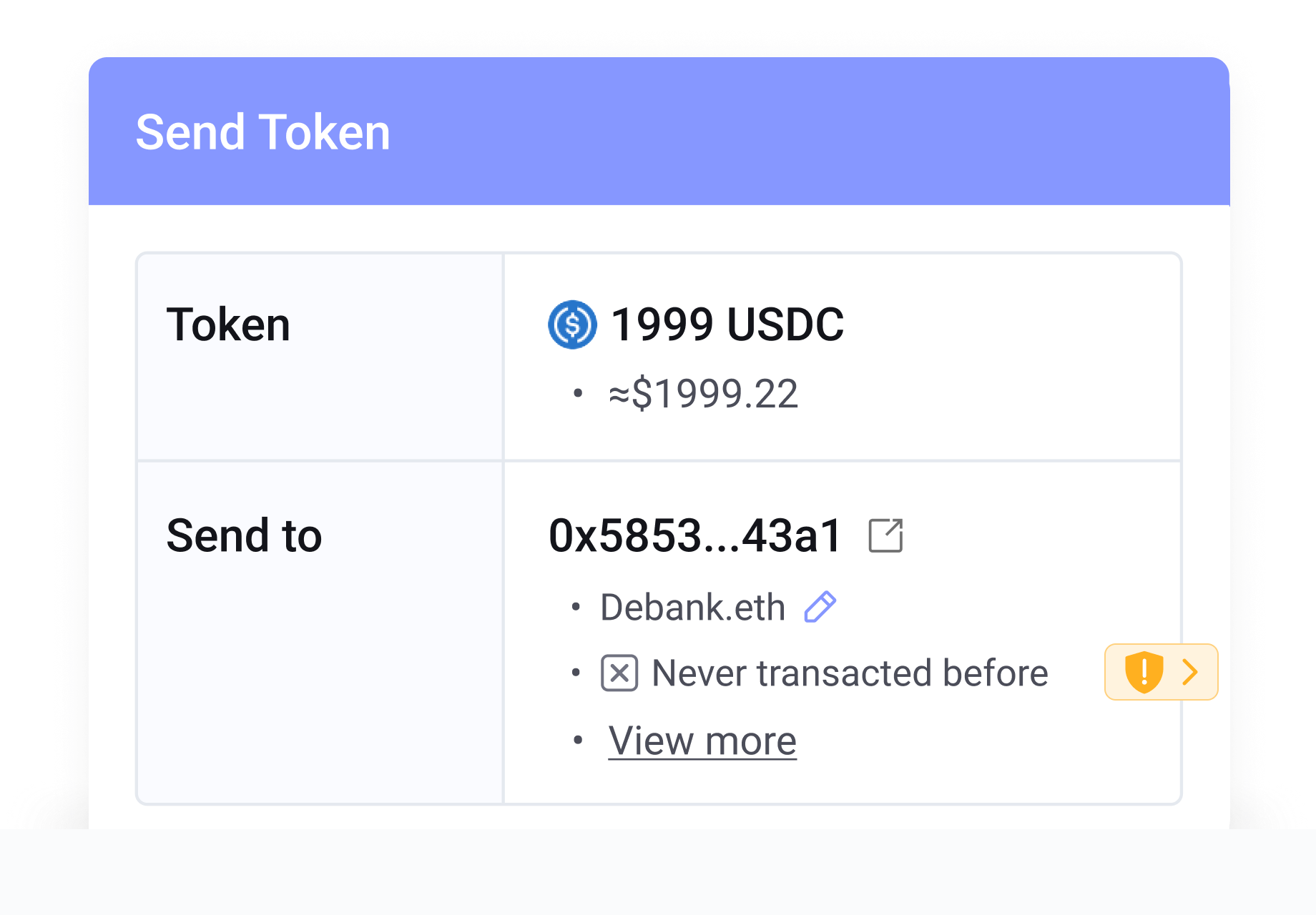
How Rabby works at the mechanism level
Rabby is a non-custodial, multi-chain wallet created by DeBank that runs as a browser extension (Chrome, Brave, Edge), with mobile and desktop clients available. Its design centers on intercepting the standard browser-wallet flow and inserting automated checks and a simulation step before the user signs a transaction. That simulation is the core technical feature: Rabby takes the signed transaction data, runs it through a local or remote execution engine against the target chain (or a local state snapshot), and displays estimated token balance changes and the expected gas cost. In practice that means you can see the precise token deltas a transaction would cause instead of trusting a generic “approve” label.
Complementing simulation is Rabby’s pre-transaction risk scanning. It compares targets against lists and heuristics—previously exploited contracts, suspicious approval patterns, or invalid recipient addresses—and surfaces warnings. The extension also auto-switches the browser to the network the dApp expects, avoiding the common friction of manual network selection. For power users who juggle more than a half-dozen EVM chains, the multi-chain support (90+ EVM chains) and cross-chain gas top-up feature are functional time-savers.
Myth-busting: what Rabby prevents — and what it doesn’t
Misconception 1: “A simulation equals perfect protection.” Not true. Simulation reduces the risk of blind signing by showing intended balance changes, but it cannot stop every exploit. Simulations depend on accurate state—if the node or the snapshot is stale, if the smart contract uses on-chain randomness or time-sensitive calls, the simulation might miss behavior that only appears at execution time.
Misconception 2: “Pre-transaction scanning will catch every malicious contract.” Rabby’s engine flags many classes of bad behavior—known hacked addresses and obvious suspicious approvals—but novel or well-disguised scams may pass heuristics. The wallet is open-source under MIT, so independent audit is possible and beneficial, but openness doesn’t equal invulnerability.
Misconception 3: “Open-source means safe by default.” Open-source architecture makes auditing feasible and often improves security, but it also exposes implementation details attackers can study. The right interpretation is: open-source permits stronger, community-driven review; it does not eliminate the need for operational caution or complementary defenses like hardware wallets and multi-sig for high-value accounts.
Where Rabby fits compared with common alternatives
Rabby’s nearest peer set includes MetaMask, Trust Wallet, and Coinbase Wallet. Each trades off different priorities:
– MetaMask: the dominant general-purpose extension with a huge ecosystem. Strength: ubiquity and integrations. Weakness: historically less emphasis on pre-execution simulation by default. Rabby differentiates by surfacing transaction simulations and automated network switching to reduce accidental interactions.
– Trust Wallet and Coinbase Wallet: mobile-first solutions with fiat on-ramps and integrated services. Strength: convenience for on-ramping and consumer workflows. Weakness: less browser-extension focused tooling for complex DeFi flows and limited pre-signature simulation features compared to Rabby.
– Institutional integrations: Rabby supports enterprise tools (Gnosis Safe, Fireblocks, Amber, Cobo) and hardware wallets (Ledger, Trezor, Keystone, and others). That positions it as a bridge between single-key browser convenience and higher-assurance custody arrangements—useful if you rotate between a hot browser account and cold or multi-sig custody for larger reserves.
Trade-offs and practical limits
Rabby makes a deliberate trade: it introduces richer, contextual information before signing at the cost of a slightly more complex UX and heavier reliance on simulation infrastructure. For the majority of routine transactions that trade pays off. For highly time-sensitive trades (e.g., flash arbitrage or time-of-deal liquidity sweeps), the added simulation step could introduce latency or small differences versus raw signed transactions executed immediately.
Two concrete limitations matter for adoption in the US market. First, Rabby lacks a native fiat on-ramp: you still need an exchange or third-party service to turn dollars into crypto. Second, there is no built-in in-wallet staking interface, so yield-seeking users must use external staking platforms or their native chain staking UIs. Both gaps are operational, not security flaws, but they shape which users will prefer Rabby as primary wallet versus a complement to other apps.
Finally, history matters. In 2022 a Rabby Swap contract was exploited for about $190,000. The team froze the contract, compensated users, and increased audits—actions that signal responsiveness and an organizational commitment to remediation. Yet the incident is a reminder: every piece of infrastructure, including wallets, is part of a complex attack surface involving smart contracts they interact with; wallets can reduce but not eliminate systemic risk.
Installation and first-run checklist for DeFi power users
If you decide to install the Rabby Chrome extension (or another Chromium-based browser), follow a security-first checklist:
1) Verify the extension source carefully—install from the official store page or the authorized project link. 2) Import wallets only using the seed phrase in a secure environment; prefer hardware wallet integration for high-value accounts. 3) Enable the simulation and approval revocation features in settings and review token approvals frequently. 4) For institutional accounts, connect Rabby to your multi-sig or custody provider instead of moving funds into a single private key. 5) Test with a small amount and a harmless transaction to see the simulation output and the auto-switching behavior in action.
For convenience, you can read an official overview and get installation pointers at the project’s user-facing summary: rabby wallet.
One reusable heuristic: the “three confirmations” before approving
When deciding whether to sign an approval or execute a complex swap, run these three quick checks every time: 1) Simulation: do the token balance deltas match your intention? 2) Approval scope: is the allowance capped and limited in time or to the specific asset? If unlimited allowances are proposed, prefer using the revocation tool or setting a small allowance. 3) Contract provenance: is the receiving contract commonly used and audited, or is it new/unverified? If any check fails, pause and research. This simple framework turns Rabby’s features into an operational habit rather than a passive UI nicety.
What to watch next — conditional scenarios and signals
Several conditional developments would change Rabby’s utility profile. If Rabby added a native fiat on-ramp while preserving its security-first model, it would be more attractive to US users who want a single app for on-ramp plus DeFi interactions. If the team expands native staking and yield interfaces, Rabby could compete directly with mobile-first wallets. Conversely, any further smart contract incident affecting core Rabby services would rightly increase scrutiny and slow adoption among institutional users.
Short of those events, watch for improvements to simulation fidelity (better node selection, deterministic replay) and broader adoption of approval revocation as a standard across wallets. Those incremental advances would lower the baseline risk for routine DeFi use without changing the fundamental need for good operational hygiene.
FAQ
Does Rabby make blind signing impossible?
No. Rabby’s transaction simulation and pre-transaction scanning significantly reduce the risk of blind signing by showing exact balance changes and flagging known risks, but they cannot guarantee protection against every novel exploit or state-dependent behavior. Simulations depend on accurate state and deterministic contract behavior; where those assumptions fail, risks remain.
Can I use Rabby with my Ledger or Trezor?
Yes. Rabby supports hardware wallet integrations (Ledger, Trezor, Keystone, and others). For high-value funds, pairing Rabby’s UX and simulation features with a hardware signer is a recommended balance between daily usability and stronger key protection.
Is Rabby better than MetaMask for DeFi power users?
“Better” depends on priorities. If your top concerns are pre-signature visibility, automatic network switching, and a built-in approval revocation tool, Rabby offers feature-level advantages. If you prioritize maximal ubiquity, wallet-connect integrations, or a larger plugin ecosystem, MetaMask might still lead. Many advanced users run both and flip defaults as needed.
What are the best practices after installing Rabby?
Use hardware wallets for large balances, enable and read simulation outputs before every signature, regularly review approvals with Rabby’s revocation tool, and keep a small hot-wallet balance for daily activity while cold-storing high-value assets or using multi-sig for institutional holdings.